
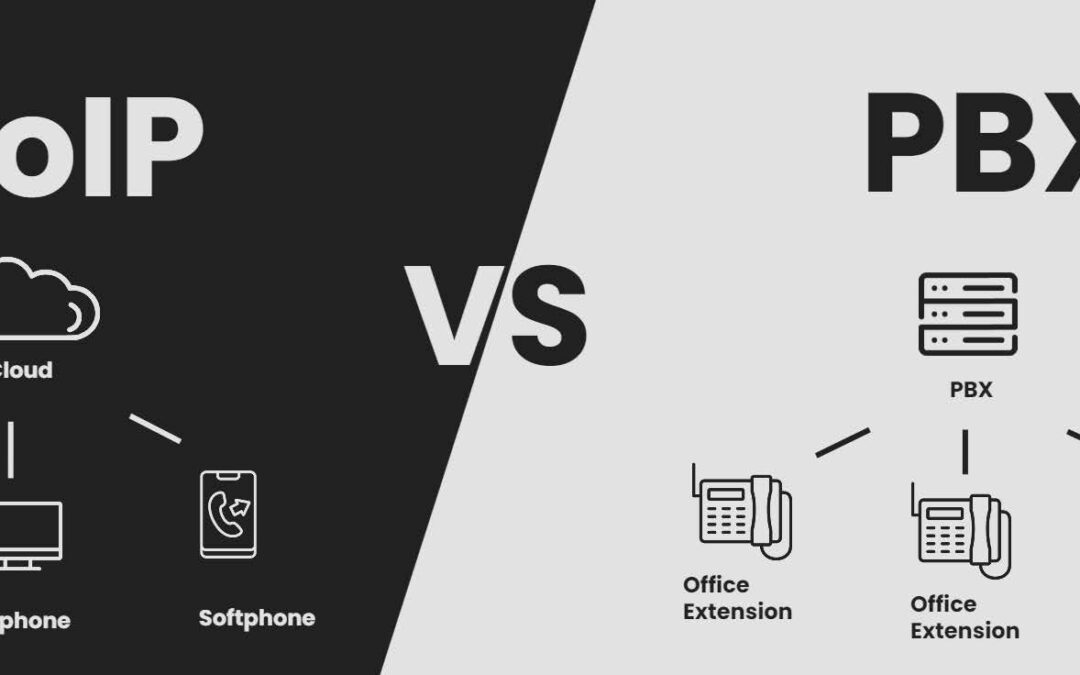
If you're shopping for a new business phone system, you've probably run into these two terms: VoIP and PBX. They both let your team make and receive calls, but under the hood they work very differently, and that difference shows up in your monthly bill. Here's a basic breakdown to help you figure out which one makes sense for your business.
What's the Difference?
A traditional PBX (Private Branch Exchange) at this point is old-school phone technology. It uses a physical box of equipment sitting in a closet at your office, connected to copper phone lines. Every desk phone plugs into that box, and that box handles routing calls in and out of the building.
VoIP (Voice over Internet Protocol) skips the copper lines and hardware closet completely. Instead, calls travel over your internet connection as data, the same way a video call or streaming a show does. Your phone system lives in the cloud, managed by your provider.
Feature Comparison
Traditional PBX systems were built decades ago, so they tend to only do one thing well: handle calls at a fixed desk in a fixed building. Anything beyond that; voicemail-to-email, video conferencing, call recording, or letting someone answer the office line from their cell phone, usually means bolting on extra equipment or paying for a separate tool.
VoIP systems, by contrast, are built for how people work today. Most VoIP plans include things like:
- Mobile and softphone apps so employees can make and take business calls from a laptop or phone, anywhere with internet
- Auto attendants and call routing that don't require extra hardware
- Voicemail-to-email or voicemail-to-text
- Video conferencing and team messaging bundled into the same platform
- Call analytics and recording for training or quality checks
- Easy scaling for adding a new employee's line is usually a few clicks, not a service call
- CRM Integration Depending on provider and plan, you can also integrate your phone system with your CRM for call tracking
One tradeoff worth knowing: a traditional PBX with analog lines can sometimes keep working during an internet outage, since it doesn't depend on your connection. Most VoIP providers offset this with automatic call forwarding to a cell phone or backup internet, but it's a fair question to ask a provider about.
The Cost Difference
This is usually where the decision gets made. Traditional PBX systems are expensive to install because you're buying physical equipment and paying for labor to wire it in. For a small office of around 20 people, one telecom industry cost analysis puts a traditional PBX installation at roughly $10,800 to $33,900 before a single call is placed. On top of that upfront hit, you're still paying monthly carrier fees per phone line, plus maintenance costs whenever something breaks.
VoIP flips that cost structure around. There's little to no hardware to buy and that same analysis estimates a comparable VoIP setup for a similarly sized office at well under a quarter of that upfront hardware cost, and it can be close to zero if your team just uses an app on the computers and phones they already have. Instead, you pay a predictable per-user monthly fee. One 2026 pricing breakdown puts typical VoIP plans somewhere between $20 and $50 per user per month, depending on the features included. That monthly fee usually covers the software, ongoing updates, and support, so there isn't a separate maintenance bill waiting to surprise you.
Zoom out over a few years, and the gap gets bigger. One industry comparison estimates total VoIP costs run roughly 50 to 75 percent lower than a traditional phone system over the life of the system, once you factor in lower long-distance charges, no repair costs, and no need to buy new hardware every time you add an employee, except maybe a phone.
Which One Should You Choose?
For most small and mid-sized businesses today, VoIP is the more practical choice. It costs less to install, costs less to run, and comes with modern features that PBX systems simply weren't designed to offer. Traditional PBX still has a narrow use case for businesses in areas with unreliable internet or specific legacy equipment they can't yet replace, but for everyone else, the math and the features both point toward VoIP.
If you're weighing the switch and want to talk through what it would look like for your specific office, check out our VoIP phone services, we're happy to walk you through setup, cost, and what features actually make sense for your team.