
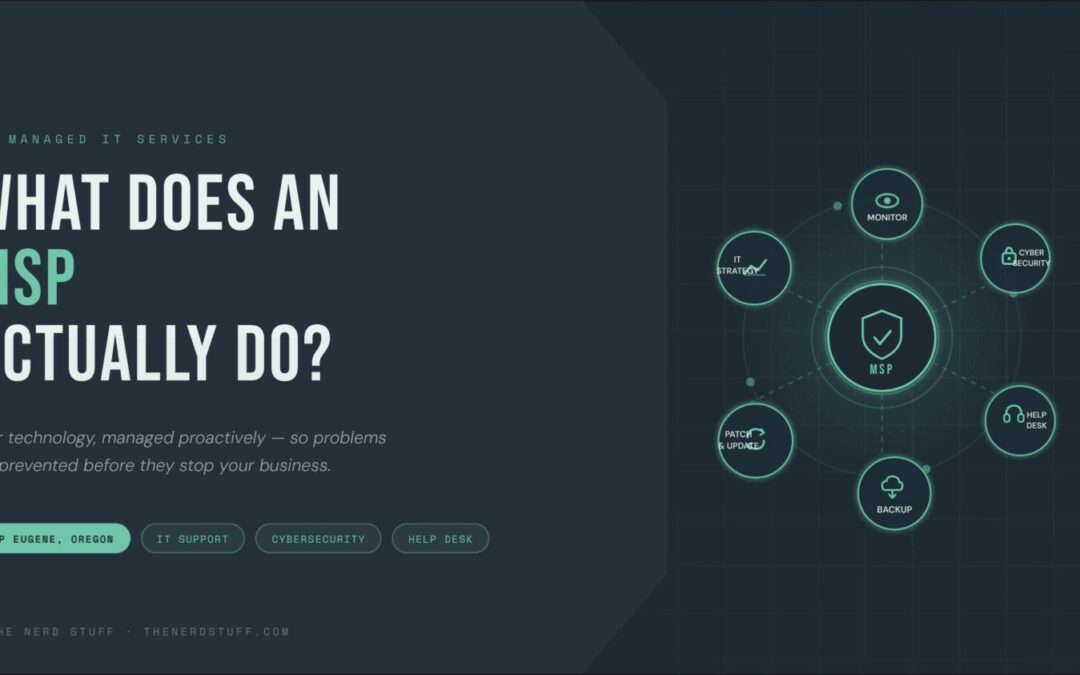
If you've heard the term "MSP" but aren't sure what one actually does or whether your business needs one, this is the plain-English breakdown you've been looking for.
"MSP" gets thrown around a lot in business technology conversations, but for many small and mid-sized business owners, the term still isn't entirely clear. You know it has something to do with IT. You've probably heard it from a vendor, a business peer, or maybe a company reaching out to offer their services. But what does a Managed Service Provider actually do and how do you know if partnering with one makes sense for your business?
Here's the straightforward answer.
The Short Version
A Managed Service Provider is a company that takes responsibility for managing your business's technology, proactively, consistently, and for a predictable monthly fee. Instead of calling someone only when something breaks, an MSP monitors and maintains your systems around the clock so that fewer things break in the first place.
Think of it like the difference between only seeing a doctor when you're seriously ill versus having a primary care physician who monitors your health regularly, catches problems early, and keeps you from ending up in the emergency room. An MSP is the primary care physician for your business technology.
What a MSP Actually Handles Day to Day
The scope of what a Managed Service Provider handles varies by provider, but a full-service MSP typically covers:
Network and infrastructure monitoring. Your servers, computers, firewalls, routers, and network equipment are monitored continuously. If something starts behaving abnormally, even in the middle of the night, your MSP is alerted and responds before it becomes a problem that stops your team from working.
Cybersecurity management. This includes keeping your antivirus and anti-malware tools updated, managing your firewall, monitoring for suspicious activity, applying security patches, and helping your team avoid threats like phishing emails and ransomware. Cybersecurity isn't a one-time setup, it requires ongoing attention, and an MSP provides exactly that.
Help desk and technical support. When your team runs into a technology problem; a computer that won't connect to the network, an email issue, a software glitch, a printer that's stopped working, they call or message your MSP's helpdesk for fast resolution. This replaces the need for a dedicated in-house IT person on staff.
Data backup and disaster recovery. An MSP ensures your business data is backed up regularly and that a recovery plan exists if something goes wrong; whether it's a hardware failure, a ransomware attack, or an accidental file deletion.
Software and system updates. Keeping software patched and up to date is one of the most important and most neglected aspects of IT security. An MSP handles this automatically, closing vulnerabilities before cybercriminals can exploit them.
Strategic IT planning. A good MSP doesn't just fix problems, they help you plan ahead. As your business grows, your technology needs to grow with it. An MSP advises on upcoming hardware refresh cycles, software investments, and technology decisions that align with your business goals.
Why Businesses Choose an MSP Over In-House IT
For many small and mid-sized businesses, hiring a full-time, qualified IT professional isn't cost-effective. A skilled IT staff member commands a significant salary, and a single person can't realistically cover every area of expertise a modern business needs; network infrastructure, cybersecurity, cloud management, compliance, and end-user support all require different skill sets.
A Managed Service Provider gives you access to an entire team of specialists across all those disciplines, typically for a fraction of what a single full-time hire would cost. For businesses in competitive markets, that's a significant operational and financial advantage.
What a Local MSP Brings to the Table
Working with a local MSP adds an extra dimension that remote-only providers can't fully replicate. For businesses looking for an MSP in Eugene, Oregon, having a provider who knows the local business community, can be on-site when needed, and understands the specific industries and compliance requirements common to the Pacific Northwest makes a meaningful difference in the quality and responsiveness of the relationship.
Local MSPs are also invested in the success of the businesses around them. When your business grows, your MSP grows with you, that kind of partnership is harder to build with a faceless national provider.
Is an MSP Right for Your Business?
If your business depends on technology to operate, and nearly every business does today, and you don't have a dedicated, full-time IT team managing it proactively, an MSP is worth a serious look. The question isn't really whether you need managed IT support. It's whether you'd rather deal with technology problems reactively, one crisis at a time, or prevent most of them from happening in the first place.
Most business owners, once they experience the difference, never go back.
Curious what managed IT support would look like for your specific business? The Nerd Stuff offers a free 15-minute discovery call to help you figure out exactly what you need and what you don't.