
One of the first questions every business owner asks and one that deserves a straight answer, not the runaround.
If you've started researching managed IT support for your business, you've probably noticed that pricing isn't always easy to find. Many providers prefer to keep their numbers off their websites and get you on a call first. That approach frustrates a lot of business owners and understandably so. You deserve at least a ballpark before you invest thirty minutes talking to a salesperson.
So here's the honest breakdown.
How Managed IT Pricing Actually Works
Most Managed Service Providers price their services on a per-user or per-device monthly basis. Instead of paying unpredictable bills every time something breaks, you pay a flat monthly fee that covers ongoing monitoring, maintenance, helpdesk support, and proactive management of your technology.
This predictable model is one of the biggest advantages of managed IT over the old "break-fix" approach, where you'd call someone only when things went wrong and pay an hourly rate to get them fixed. Break-fix feels cheaper on paper until you have a serious problem, and then the bills can be eye-watering.
What Are the Typical Price Ranges?
Managed IT pricing varies based on the size of your business, the services included, and the provider's level of expertise. Here's a general range you can use for budgeting:
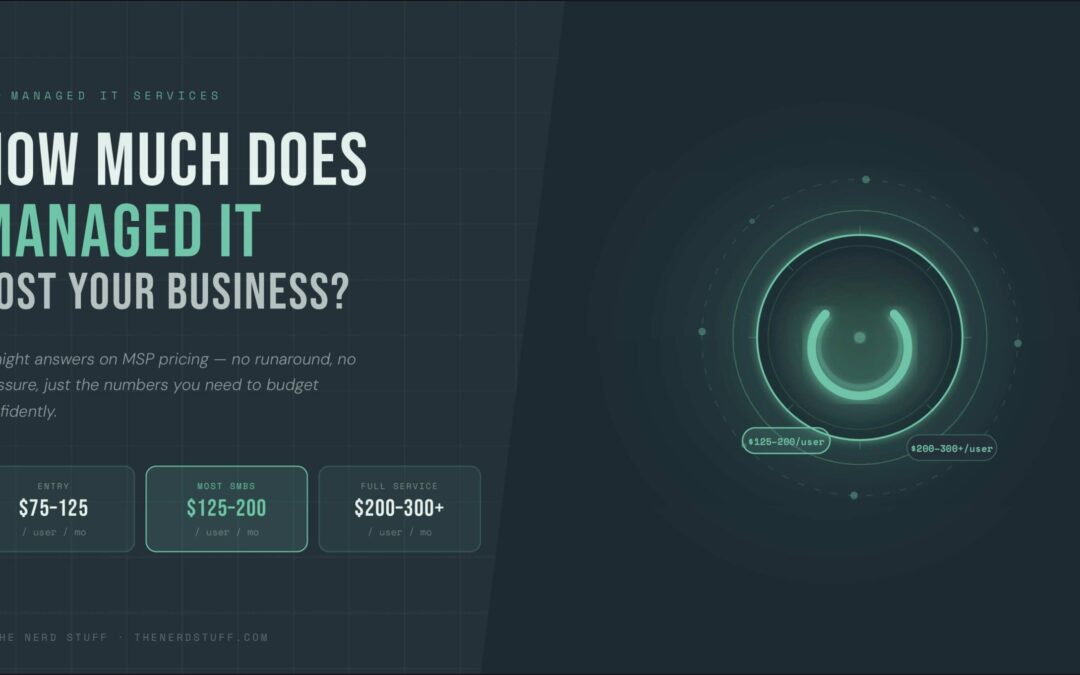
Entry-level managed IT (basic monitoring and support) Roughly $75–$125 per user/device per month. This typically covers remote monitoring, basic helpdesk support, and software patch management. It's a starting point, but often doesn't include robust cybersecurity or strategic planning.
Mid-tier managed IT (most common for SMBs) Roughly $125–$200 per user/device per month. This is where most small and mid-sized businesses land. At this level you can expect proactive monitoring, full helpdesk support, cybersecurity tools, backup management, and regular check-ins with your IT partner.
Comprehensive managed IT (full-service) Roughly $200–$300+ per user/device per month. This tier typically adds advanced cybersecurity, compliance support (like HIPAA or financial data requirements), virtual CIO services, and deeper strategic involvement in your technology decisions.
For a business with ten employees, that translates to a monthly investment somewhere between $750 on the low end and $3,000 or more for a comprehensive, fully managed environment.
What Affects the Price?
Several factors push pricing up or down:
Number of users and devices. More endpoints mean more to manage and monitor. Most providers price per user, per device, or a combination of both.
Your industry's compliance requirements. Healthcare practices, law firms, mortgage companies, and other regulated industries need additional layers of security and documentation to meet compliance standards. That expertise costs more — and is worth it.
Your current infrastructure. If your hardware is outdated or your network hasn't been properly set up, there may be upfront remediation work needed before a flat monthly model kicks in.
Level of cybersecurity included. Basic antivirus is very different from advanced endpoint detection, dark web monitoring, employee security training, and email threat protection. Know what's included before comparing quotes.
On-site vs. remote support. Some MSPs include on-site visits in their pricing. Others charge separately. If you're in a market like Eugene, Oregon, having a local provider who can physically show up matters, and it's worth clarifying what that looks like in your contract.
How Does This Compare to In-House IT?
This is where managed IT often wins the cost comparison convincingly. A single qualified, full-time IT professional in the Pacific Northwest typically commands a salary of $55,000–$85,000 per year — before benefits, payroll taxes, PTO, and training. And one person can't cover every area of expertise your business needs across networking, cybersecurity, cloud management, and end-user support.
A managed IT contract at $150 per user per month for a ten-person team costs $18,000 per year — and gives you access to an entire team of specialists across every discipline, available around the clock.
What You Should Really Be Asking
Price matters, but it's not the only number worth tracking. The better question is: what does a technology failure actually cost your business?
An hour of downtime. A ransomware attack. A data breach. A week of your team working around a system that should have been fixed months ago. These costs rarely show up in a budget conversation, but they're very real and a well-managed IT environment is specifically designed to prevent them.
The right managed IT partner isn't the cheapest one. It's the one that keeps your technology running reliably, protects your data, and gives you one less thing to worry about so you can focus on running your business.
Want to know what managed IT support would actually cost for your specific business? The Nerd Stuff offers a free 15-minute discovery call with no pressure and no runaround, just straight answers.