



January 19, 2026
January is the perfect time to address all the tasks you've been postponing.
Whether it's scheduling a doctor's appointment, visiting the dentist, or finally investigating that odd noise coming from your car.
Preventive maintenance might seem dull, but it's far less costly than dealing with a crisis that could have been avoided.
Let's confront a crucial question:
When was the last time your business technology underwent a comprehensive checkup?
Not just when "the printer was fixed last week," but a thorough health assessment.
Remember, functioning isn't the same as being in good health.
Beware the "I Feel Fine" Illusion
Many people skip medical checkups simply because they don't feel pain.
Similarly, businesses often neglect technology inspections for reasons like:
"Everything seems fine."
"We're too busy to pause."
"We'll handle issues when they appear."
Here's the harsh truth: technology issues rarely give advance warnings.
Just as your blood pressure can be dangerously high without symptoms, or a cavity can silently damage a tooth, tech problems often lurk unseen until they erupt into emergencies.
Business technology behaves the same way.
The causes of tech failures in small businesses typically stem from:
- Known vulnerabilities that were neglected
- Outdated hardware that seemed "okay" until failure struck
- Backups that exist in theory but fail upon restoration attempts
- Unsecured access privileges left unchecked
- Compliance gaps overlooked by the team
Your systems might seem operational externally yet remain just a single failure away from a serious outage.
What to Expect from a Thorough Tech Health Check
A professional technology assessment mirrors a medical exam — it systematically uncovers hidden vulnerabilities within your business systems.
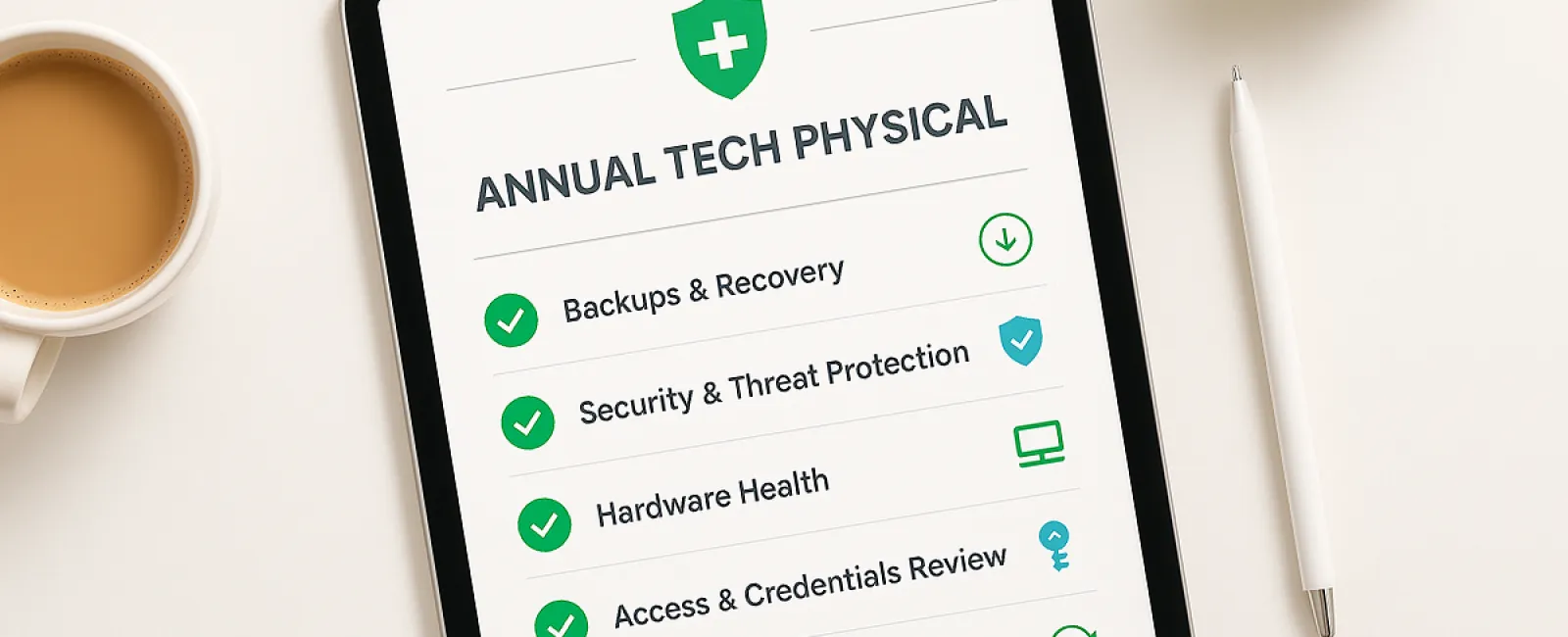
Vital Check: Backup and Recovery Systems
This represents the lifeline of your IT infrastructure. When everything goes wrong, recovery depends on this.
• Are backups completing successfully, not just scheduled?
• When was the last time you tested restoring a file and confirmed its integrity?
• If your server crashed at 9 a.m. on Monday, how soon could you resume operations? Do you have a definite answer?
Many businesses only realize their backups are faulty during a crisis — similar to discovering your car's airbags are nonfunctional in an accident.
Core Health: Hardware and Network Infrastructure
Technology hardware doesn't fail quietly. It ages, loses support, degrades in performance, and ultimately breaks down — often at the worst possible time.
- How old is your critical equipment like servers, firewalls, and workstations?
- Is any hardware beyond vendor support, meaning no more security patches or fixes?
- Are you proactively upgrading, or waiting for devices to fail catastrophically?
Outdated equipment is a leading unseen cause of downtime — operating slower before a sudden total failure.
Security Analysis: Access Permissions and Credentials
Do you know exactly who has access to your systems? If your answer is vague, it's time for a review.
- Can you provide a detailed list of current access holders?
- Are former employees or expired vendors still active in your system?
- Are there shared accounts making it impossible to track user actions?
Access creep is a common security pitfall in small businesses — often unintentional but risky without regular cleanup.
Disaster Preparedness: Emergency Readiness Screening
Many avoid contemplating worst-case scenarios, but that's exactly why it's crucial to prepare.
- Do you have a practical plan if ransomware strikes tomorrow?
- Is your recovery plan documented and regularly tested?
- How long could your business operate without its IT systems?
Relying on "we'll figure it out" isn't a strategy — it's wishful thinking.
Industry Compliance: Specialized Regulatory Checks
Every sector has its distinct compliance standards that must be met to avoid penalties.
- Healthcare organizations must adhere to HIPAA rules, with fines up to $50,000 per violation.
- Businesses processing credit cards need PCI compliance to avoid losing payment privileges.
- Contracts may mandate specific security requirements increasingly enforced by clients.
Generic IT advice isn't enough — you need experts familiar with your industry's unique demands.
Signs You're Due for a Tech Checkup
If any of these ring true, it's time to act:
"I think our backups are fine." (Guesswork is risky.)
"Our server is old but still working." (Like a car before a breakdown on the highway.)
"We probably still have former employees in the system." (Probably is not safe.)
"We have a disaster plan somewhere." (If you can't locate it quickly, it might as well not exist.)
"Losing [name] would cause serious disruptions." (Single points of failure guarantee downtime.)
"We might fail an audit but no one has asked yet." (Waiting is risky.)
The Price of Neglect
A scheduled checkup only takes hours.
A system failure can cost days, weeks, or even the future of your entire business.
Data Loss: Without reliable backups, losing your server could erase all client data, finances, and projects — sometimes permanently.
Downtime: Every minute your systems are offline leads to lost revenue, disrupted work, missed deadlines, and damaged client trust.
Compliance Penalties: HIPAA fines can reach $50,000 per breach. PCI failures risk payment processing. Privacy laws impose increasing fines annually.
Ransomware Impact: Recovering from attacks often costs small businesses six figures, including ransom payments, remediation expenses, lost income, and reputational harm.
Investing in prevention may seem dull but is inexpensive.
Facing recovery is costly and embarrassing.
Why You Need an Expert, Not a Self-Check
You wouldn't measure your own blood pressure and diagnose yourself — professionals have the knowledge, tools, and experience to accurately assess your health.
IT works the same way.
You require a specialist who:
- Understands what healthy technology looks like for a business of your size and industry — not generic advice but tailored standards.
- Recognizes common pitfalls specific to your sector, spotting early signs of bigger issues.
- Brings a fresh perspective to identify problems you might have normalized.
This proactive approach equals fire prevention rather than firefighting.
Book Your Technology Health Assessment Today
As you schedule your personal preventive care this January, don't forget your business technology.
Arrange an Annual Tech Physical with us.
We'll deliver a straightforward health report outlining what's secure, what's at risk, and what requires immediate attention before it escalates into a crisis.
No confusing jargon. No pressure. Just clear insight.
Click here or give us a call at (541) 726-7775 to book your 15-Minute Discovery Call.
The optimal moment to identify problems is before they escalate.
And that moment is today.


